

Quick Pickleball Rules: The Ultimate Pocket Card
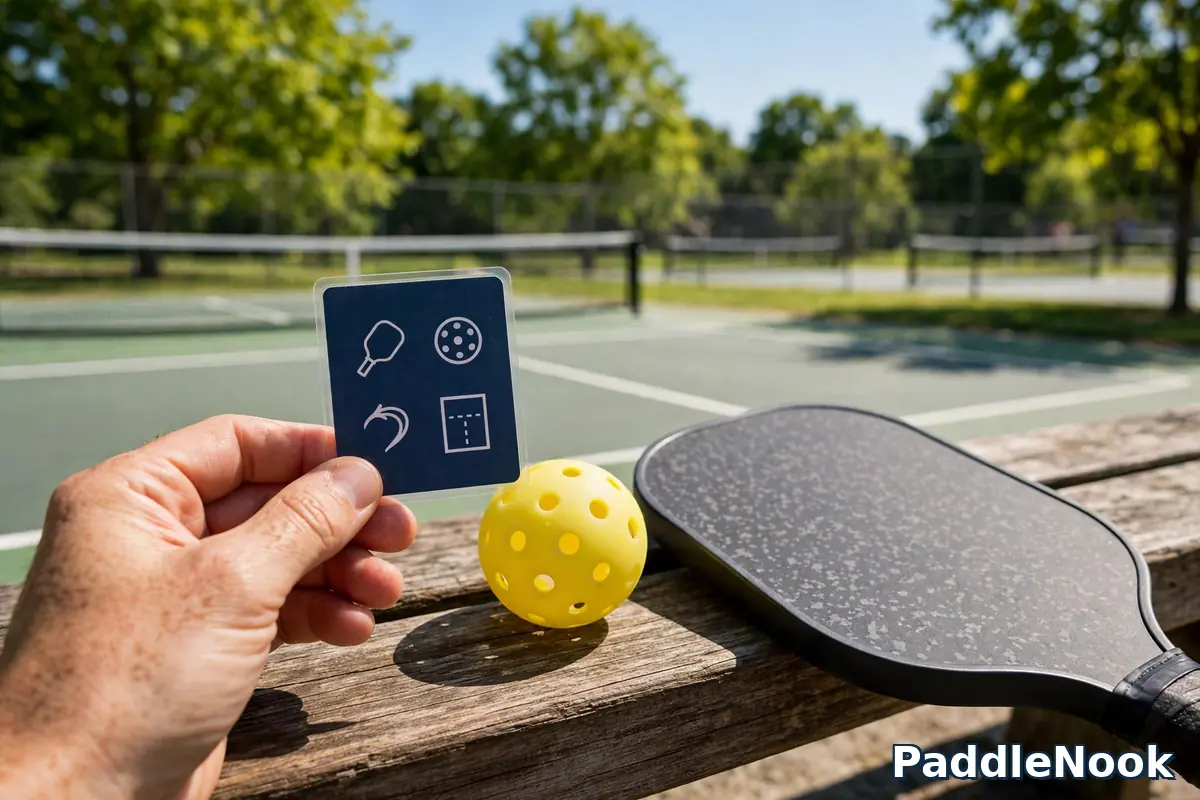
Quick pickleball rules are all you need before your first game, and you can learn them in about one minute if you skip the details for now. You do not need the full rulebook, a coach, or a long lesson. You need five short rules, a way to call the score, and one calm rule for when you disagree.
This pocket card gives you exactly that, in the order you will use it on court. Read it once before you play, keep it in your head during the game, and check it between games if a point feels unclear. The rest can wait until your second game, when the basics already feel natural. If a friend asks what the game is, you can answer with this card alone, and you will sound confident even on your first visit to a court.
What Are the Quick Pickleball Rules, on One Card?
Quick pickleball rules, on one pocket card, are: serve underhand and diagonally, let the ball bounce once on each side, do not volley from the kitchen, score only while serving, and play to 11 points, winning by two, with the score called before every serve.
That is the whole card in one paragraph, and it is enough for a friendly game. The sections below explain each line in plain words, so you can answer a question on court without stopping the game for long.
| Line | Pocket rule | Court check |
|---|---|---|
| 1 | Serve underhand, diagonal | Behind the baseline, below the waist |
| 2 | Two bounces first | Serve bounces, return bounces, then play |
| 3 | Kitchen, no volleys | Bounced balls only, from inside the zone |
| 4 | Score only while serving | Win on your serve, or win the serve back |
| 5 | Play to 11, win by 2 | Call the score, every serve, out loud |
How Do You Serve, Fast?
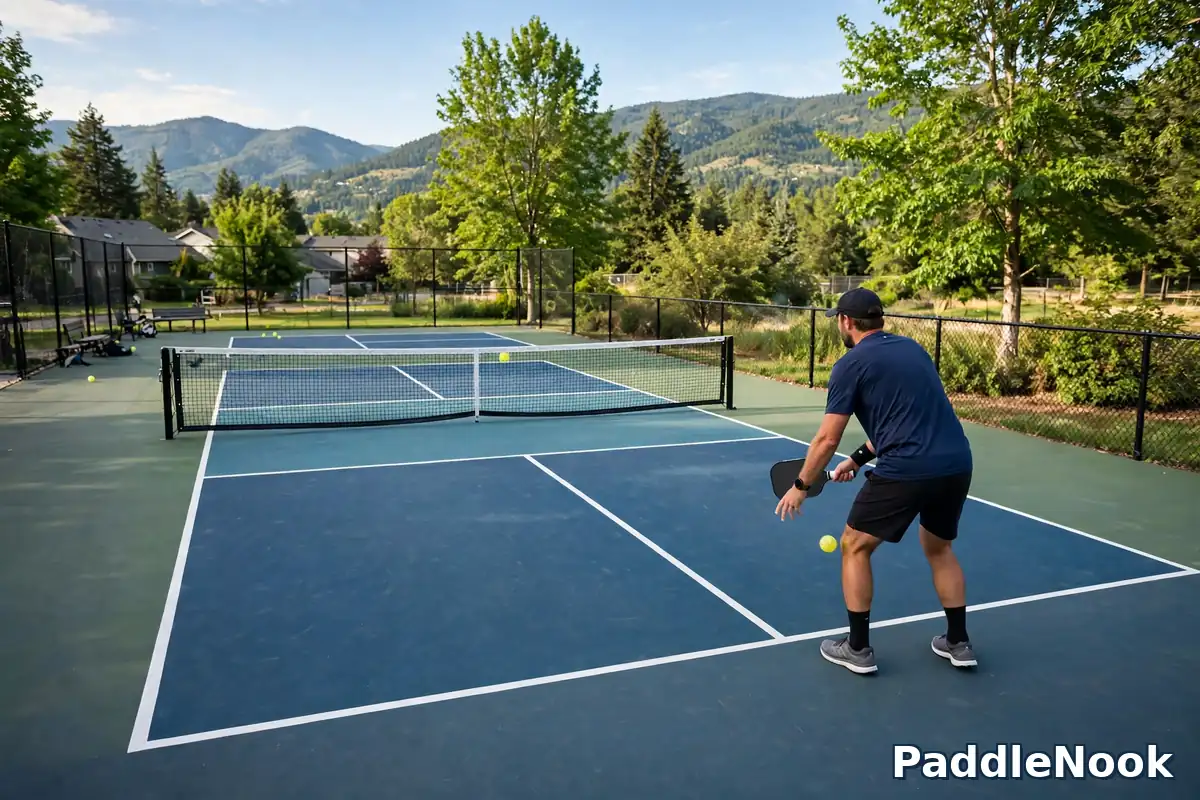
Stand behind the baseline, with at least one foot behind the line. Hit the ball underhand, below your waist, with an upward swing, diagonally into the opposite service box. The serve must clear the net and clear the kitchen zone.
A drop serve is the easiest quick choice. Drop the ball, let it bounce, then hit it after the bounce, without throwing it down.
You get one serve attempt, unless the ball clips the net and still lands in the right box. A serve that lands in the kitchen, or on its line, is a fault, and the rally ends at once.
Why Must the Ball Bounce Twice?
The two-bounce rule is the rule that keeps the start of every point fair. After the serve, the receiving side must let the ball bounce before returning it. Then the serving side must let that return bounce before hitting it back.
Only after those two bounces can either side volley, which means hitting the ball before it bounces.
Say it to yourself before you play: serve, bounce, return, bounce, then play. Once that pattern is in your head, you will stop volleying too early, which is the most common quick-game fault.
What Is the Kitchen, in One Line?
The kitchen is the 7-foot non-volley zone on each side of the net. You may stand in it, and you may hit a ball that has bounced while you are in it. You may not volley while you are in it, or while you or your paddle touches its line.
Momentum counts too, so if a volley carries you into the kitchen, even after the shot, that is a fault. Step back, balance, and only then volley again, and you will avoid most kitchen faults in a quick game.
For a fuller plain-English walkthrough, see a simple definition of the sport.
How Do You Score, Fast?
Only the serving side scores in traditional scoring. Win a rally while serving, and you score one point and keep serving. Lose a rally while serving, and no point is scored, and the serve moves on.
Call the score out loud before every serve. In doubles, call three numbers: your score, your opponents’ score, and the server number, 1 or 2. At the start, the call is 0-0-2, because only the second server serves first.
What Ends a Rally, Fast?
A fault ends the rally at once. Use this quick check when play stops and you are not sure why: ball out, ball into the net, volley from the kitchen, volley before the two bounces, or ball bounced twice on one side.
When in doubt in a friendly game, replay the point and move on. That one rule saves more friendly games than any other rule on this card, because it keeps the mood good and the game moving.
What Should You Skip Until Game Two?
Skip the fine details on your first game, and you will enjoy it more. Skip spin, advanced serves, and long strategy talks, and skip any rule that has not come up in a real rally yet. Learn those later, one at a time, after the five pocket rules feel easy.
USA Pickleball gives a clear overview of the basics on its What Is Pickleball page. Our zone-by-zone tour of the court explains each line in plain words, when you are ready for game two.
People Also Ask
Can I learn pickleball rules in one minute?
Yes, for a friendly game. Learn the serve, two bounces, kitchen, scoring, and game end, then add details as you play.
What if I forget a rule during a game?
Stop, check the pocket card in your head, and ask your partner or opponents calmly. In a friendly game, replay the point if you cannot agree.
Do I need to know rally scoring for a quick game?
No.
What is the fastest way to look ready on court?
Call the score before every serve, wait for the two bounces, and stay out of the kitchen for volleys. Those three habits look confident at once.
Conclusion
Quick pickleball rules fit on one card: serve, two bounces, kitchen, scoring, and game end, plus a replay rule when in doubt. For a complete rules overview in plain words, see the full simple rules guide.
Play one friendly game with this card in mind, and skip the rest until game two. Pickleball by the Sea also gives a helpful short list in its quick rules guide.



One Comment