

Pickleball Rules and Scoring: The Ultimate Linked Guide
Pickleball rules and scoring feel like two separate subjects until you see how they link, and then the whole game clicks. Every rule you break, or follow, changes either the score, the server, or the side you serve from, and once you know which one, you can follow any game without asking someone to explain it every point.
This guide links them rule by rule, so you never learn a rule without learning what it does to the score. Read the map once, follow one worked sequence, and use the tracker at the end, and scoring will stop feeling like a puzzle and start feeling like a pattern. If scoring has confused you before, this is the guide that finally connects the two subjects, so you can follow a game from the first serve to the last point.
How Do Pickleball Rules and Scoring Link Together?
Pickleball rules and scoring link in one simple way: a rule decides who wins the rally, and the score rule decides what that win is worth, so a win while serving adds a point, a win while receiving only wins the serve back, and a fault ends the rally at once.
| Rule | Rally winner | What happens to the score |
|---|---|---|
| Serve fault | Receiving side | No point, serve moves on |
| Return fault | Serving side | Serving side scores 1 point |
| Kitchen volley fault | Other side | Point only if faulting side was receiving |
| Two-bounce fault | Other side | Same rule, point only while serving |
| Ball out or into net | Other side | Point only while serving |
How Does the Serve Link to the Score?
Every point starts with a serve, and the serve rule decides whether the rally counts at all. Stand behind the baseline, serve underhand, below the waist, diagonally into the opposite service box, and clear the kitchen zone, and the rally is live.
If the serve faults, the receiving side wins the rally, but no point is scored, because the receiving side was not serving. The serve simply moves on, to the server’s partner in doubles, or to the other side in singles.

How Does the Two-Bounce Rule Link to the Score?
The two-bounce rule links to the score by deciding who can win the rally early. After the serve, the receiving side must let the ball bounce, then the serving side must let the return bounce, before either side volleys.
If a side volleys too early, that side faults, and the other side wins the rally. If the faulting side was serving, no point is scored, and the serve moves on. If the faulting side was receiving, the serving side scores one point.
How Does the Kitchen Rule Link to the Score?
The kitchen is the 7-foot non-volley zone on each side of the net, and its link to the score is the same as every fault. You may stand in it and hit a ball that has bounced, but you may not volley while in it, or while touching its line.
If you volley from the kitchen, you fault, and the other side wins the rally. If you were serving, you lose the serve without scoring. If you were receiving, the serving side scores one point and keeps serving.
How Does a Worked Sequence Look, Point by Point?
Follow one doubles sequence, and the links become clear. Team A serves first, at 0-0-2, and wins a rally, so the score becomes 1-0-2, and the same server switches sides and serves again.
Team A loses the next rally, so no point is scored, and the serve passes to Team A’s partner, at 1-0-1. That partner loses a rally too, so it is a side-out, and Team B starts serving at 0-1-1, with no point added for either loss.
How Do You Call the Score, Linked to the Serve?
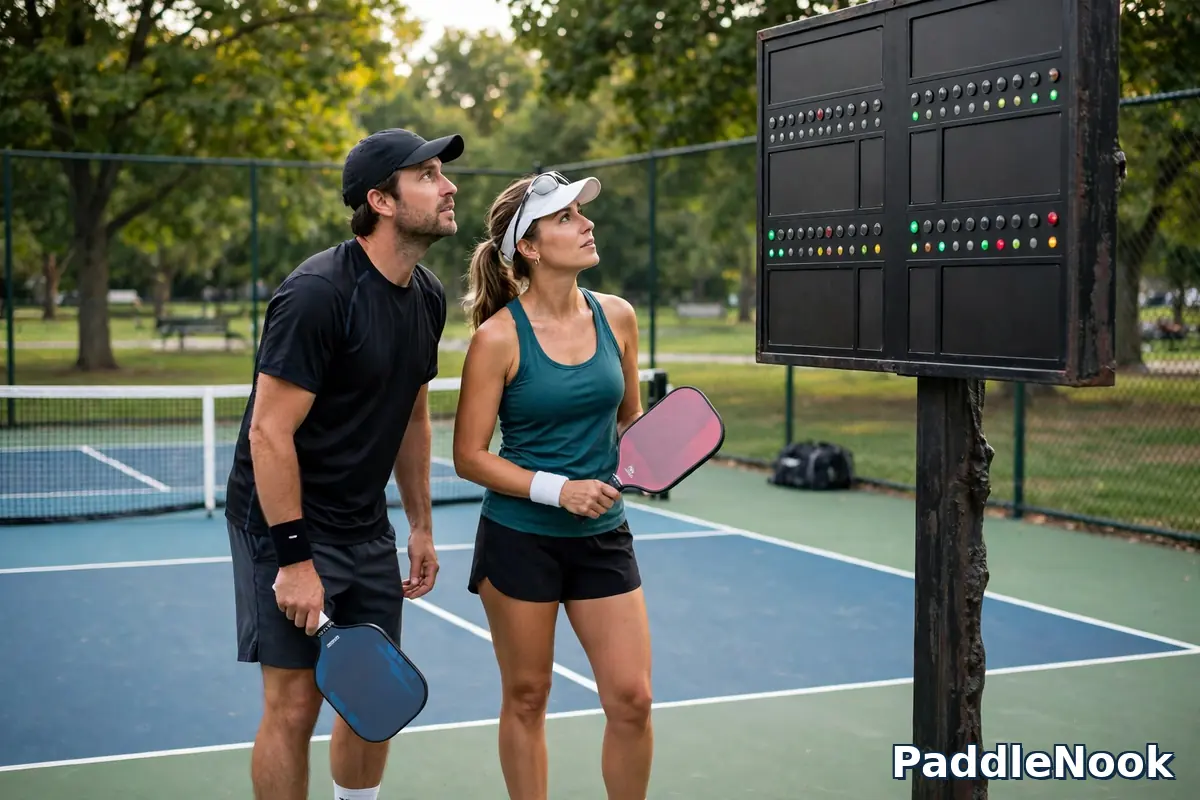
Call the score call out loud before every serve, because the call tells everyone who can score. In doubles, call three numbers: your score, your opponents’ score, and the server number, 1 or 2.
The server number matters because it tells you whether the serve will pass to a partner or to the other team after a fault. Server 1 losing a rally passes the serve to server 2, while server 2 losing a rally causes a side-out.
How Do You Track Score in a Real Game?
Use this tracker between games, until calling the score feels automatic. Write the score before each serve, circle the server number, and note whether the rally was won while serving or receiving.
| Before serve | Rally winner | After serve |
|---|---|---|
| 0-0-2 | Serving side | 1-0-2, same server |
| 1-0-2 | Receiving side | 1-0-1, partner serves |
| 1-0-1 | Receiving side | Side-out, other team serves |
| 0-1-1 | Serving side | 1-1-1, same server |
Only the serving side scores, so a fault by the serving side changes the server, not the score, and that is the mistake beginners make most. Do not add a point after a fault, add a point only after a win while serving.
A fault is any rule break that ends the rally, from a ball out to a kitchen volley. For a fuller plain-English overview, see a simple definition of the sport. USA Pickleball gives a clear overview on its What Is Pickleball page.
People Also Ask
Why can a team win rallies and still not score?
Because only the serving side scores. A win while receiving wins the serve back, not a point, until that team is serving itself.
What is a side-out, in scoring terms?
A side-out is when the serve passes to the other team, after the serving team has used both servers, or after the starting team’s single first server loses.
How do I know which side to serve from?
In doubles, follow the server number and the score call. In singles, serve from the right on an even score and from the left on an odd score.
What happens at 10-10?
Play continues until one side leads by 2 points. A game at 10-10 is not over, even though one side has reached 10 points.
Conclusion
Pickleball rules and scoring link in one pattern: rules decide who wins the rally, and serving decides what that win is worth. For a complete rules overview in plain words, see the full simple rules guide.
Use the tracker above in your next game, and call the score before every serve. Our zone-by-zone tour of the court explains each line in plain words, and the LTA also gives a helpful overview in its rules and scoring guide.




One Comment