Basic Rules of Pickleball: The Ultimate Terms-First Guide
Basic rules of pickleball sound harder than they are, because most guides use court words before they explain them. You read about a kitchen, a baseline, and a service box, and you are expected to know where each one is, even though you have never stood on a court before. That confusion is normal, and it says nothing about how good you will be at the game.
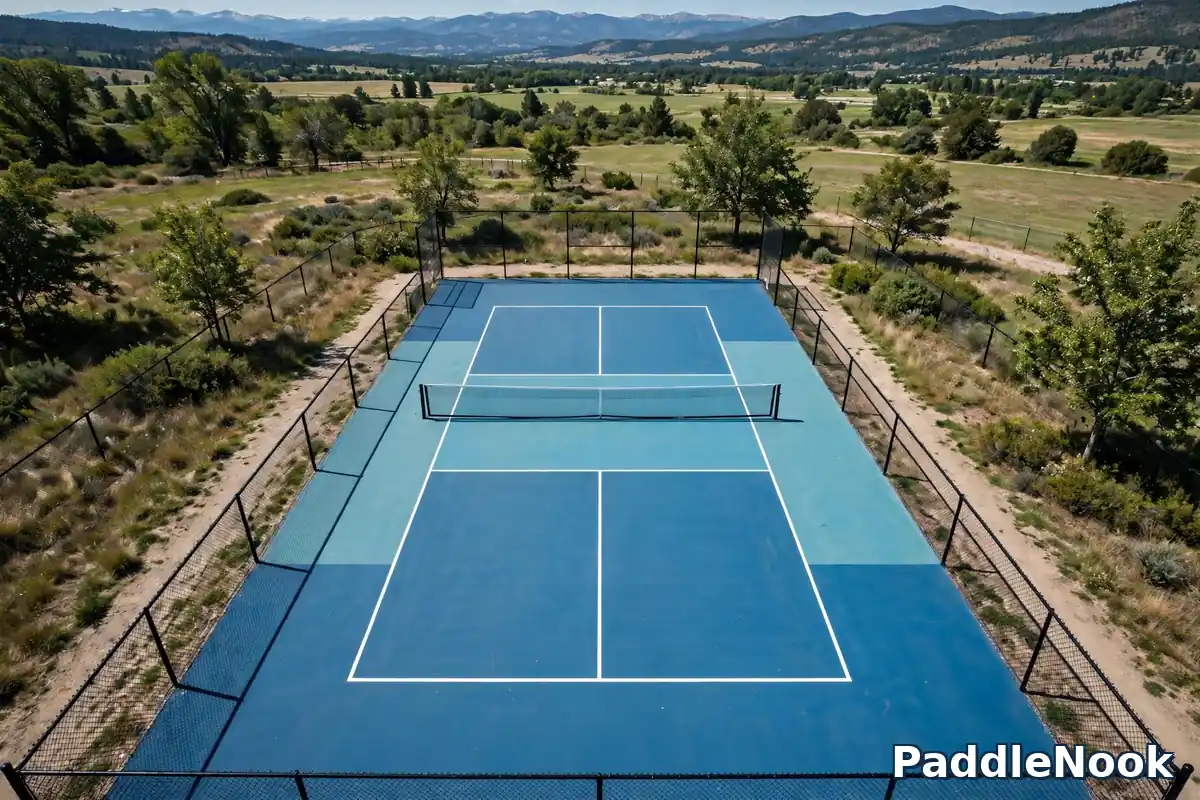
This guide fixes that order. First, you will learn the court terms in plain words, with a simple picture in your head for each one. Then, you will learn the rules zone by zone, so each rule lands in a place you already know. Think of the court as three parts, back, middle, and front, and each part has its own rule, so your first game feels far less confusing.
What Are the Basic Rules of Pickleball, in Plain Words?
Basic rules of pickleball are five short ideas, learned in court order: serve underhand and diagonally from behind the baseline, let the ball bounce once on each side, do not volley from the 7-foot kitchen, score only while serving, and play to 11 points, winning by two, with the score called before each serve.
Now you know the short version. The rest of this guide gives you the words first, then the rules, so nothing feels like jargon. Read the terms table once, and the rules after it will make sense at once.
| Term | Where it is | What it means for you |
|---|---|---|
| Baseline | Back line of the court | Serve from behind it |
| Sidelines | Outer edges of the court | Ball outside them is out |
| Service boxes | Two boxes on each side | Serve must land in one |
| Kitchen | 7-foot zone by the net | No volleys from inside it |
| Kitchen line | Line at the back of the kitchen | Do not touch it on a volley |
| Centreline | Line down the middle | Splits the service boxes |
First, the Back of the Court: Baseline and Serve
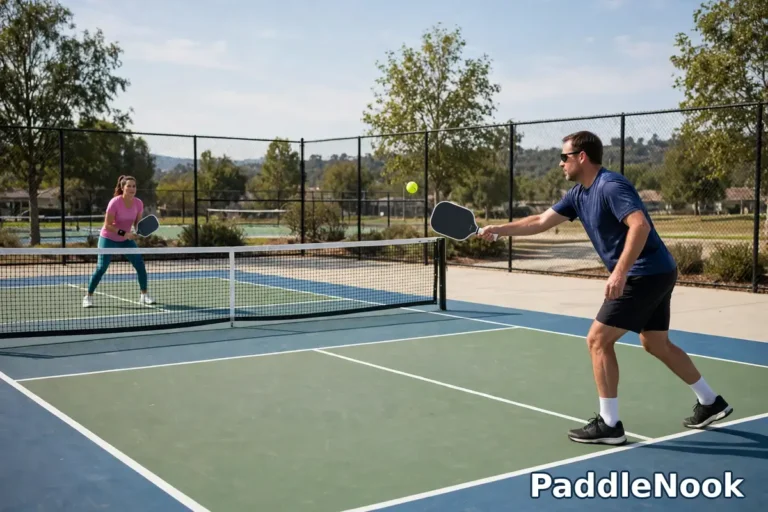
The baseline is the back line of the court. Every serve starts behind it. Stand behind it, with at least one foot behind the line, and hit the ball underhand, below your waist, with an upward swing.
Your serve must travel diagonally into the opposite service box, and it must clear the kitchen zone. A serve that lands in the kitchen, or on its line, is a fault.
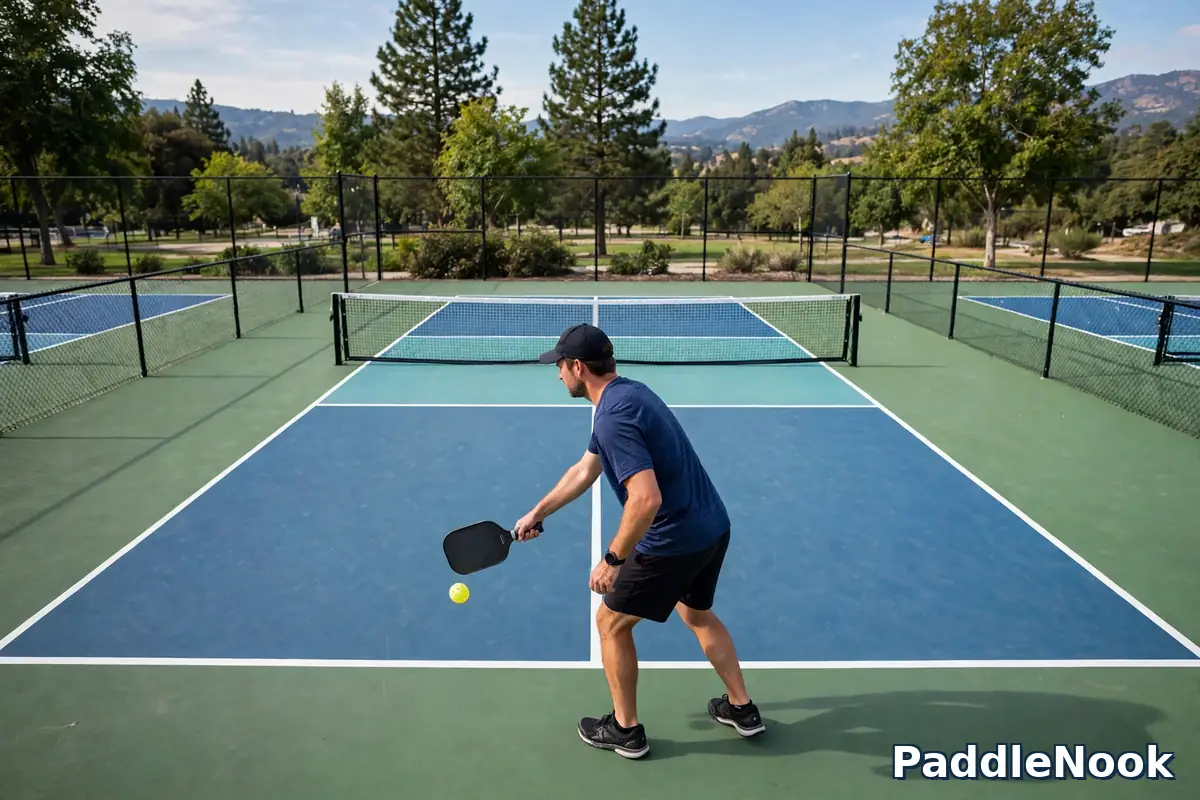
A drop serve is a good first choice. Drop the ball, let it bounce, then hit it after the bounce. Aim deep and steady, into the back half of the service box, not hard.
Next, the Middle: Two Bounces and the Service Boxes
The service boxes are the two boxes on each side, split by the centreline. They tell you where a serve must land, and where you stand to serve. Serve from the right on an even score, and from the left on an odd score, in singles.
After the serve, the two-bounce rule takes over. The receiving side must let the serve bounce, and the serving side must let the return bounce, before either side volleys.
Say the pattern to yourself: serve, bounce, return, bounce, then play.
Then, the Front: Kitchen and Kitchen Line
The kitchen is the 7-foot non-volley zone on each side of the net. You may stand in it, and you may hit a ball that has bounced while you are in it. You may not volley while you are in it, or while you or your paddle touches its line.
Momentum counts too. If a volley carries you into the kitchen, even after the shot, that is a fault. So step back, balance, and only then volley again.
A soft shot in the kitchen, called a dink, is a slow, low shot that just clears the net. For a fuller plain-English overview, see a simple definition of the sport.
Last, the Whole Court: Scoring, Lines and Faults
Only the serving side scores in traditional scoring. Win a rally while serving, and you score one point and keep serving. Lose a rally while serving, and no point is scored, and the serve moves on.
Call the score out loud before every serve. In doubles, call three numbers: your score, your opponents’ score, and the server number, 1 or 2. At the start, the call is 0-0-2, because only the second server serves first.
A ball on a line is in, except for a serve on the kitchen line, which is out. A rally ends with a fault: a ball out, into the net, volleyed from the kitchen, or volleyed before the two bounces. Our zone-by-zone tour of the court explains each line in plain words.

How Do the Zones Fit Together in One Rally?
Follow one rally, zone by zone. The server stands behind the baseline and serves diagonally into a service box. The receiver lets it bounce, then returns it deep.
The serving side lets that return bounce, then moves forward. Both sides play soft shots at the kitchen line, until one side faults, or one side wins the rally with a clean shot.
If the serving side wins, it scores and serves again. If it loses, the serve moves on, with no point scored. USA Pickleball gives a clear overview of the basics on its What Is Pickleball page.
People Also Ask
Do I need to learn the court terms first?
It helps a lot. Once you know baseline, service boxes, and kitchen, each rule has a place.
Can I stand in the kitchen?
Yes. You can stand there and hit a ball that has bounced. You just cannot volley while you are in it or touching its line.
What if I forget the score?
Stop, check with your partner and opponents, and agree on the score before the next serve.
How do I know which service box to aim for?
Aim diagonally, into the box opposite your serving side. A serve must clear the kitchen and land in that box to be legal.
Conclusion
Basic rules of pickleball are simple once the terms come first: baseline for the serve, service boxes for the target, kitchen for the net play, and the whole court for scoring. For a complete rules overview in plain words, see the full simple rules guide.
Play your next game with the terms in mind. Auburn Hills also gives a helpful short guide in its rules and basics guide.