

Pickleball Rules for Dummies: The Ultimate No-Jargon Guide
Pickleball rules for dummies means one thing only: no jargon, no shame, and no question too simple to ask. If you have never played a racket sport, if the words kitchen, dink, and side-out sound strange, or if you are worried about looking silly on court, this guide is for you, and you are exactly the player it was written for.
You do not need to be sporty, fast, or good at rules to enjoy your first game. You need a few plain words, a patient partner, and permission to get things wrong, laugh, and try again. This guide translates every tricky term, answers the questions new players are afraid to ask, and clears up the myths that confuse beginners most. By the end, you will know the words, the score, and the kitchen rule, and you will feel ready on court.
What Do Pickleball Rules Mean, in Plain Words?
Pickleball rules for dummies, in plain words, are: serve gently and diagonally, let the ball bounce twice at the start, do not hit the ball out of the air from the kitchen, score only when you are serving, and play to 11 points, winning by two.
| Tricky word | Plain meaning | Think of it as |
|---|---|---|
| Kitchen | 7-foot zone by the net, no volleys | A no-smash area |
| Volley | Hitting the ball before it bounces | Hitting it out of the air |
| Dink | A soft, low shot into the kitchen | A gentle drop shot |
| Side-out | Serve passes to the other team | Your turn to serve ends |
| Fault | A rule break that ends the rally | A mistake that stops play |
How Do You Serve, Without Jargon?
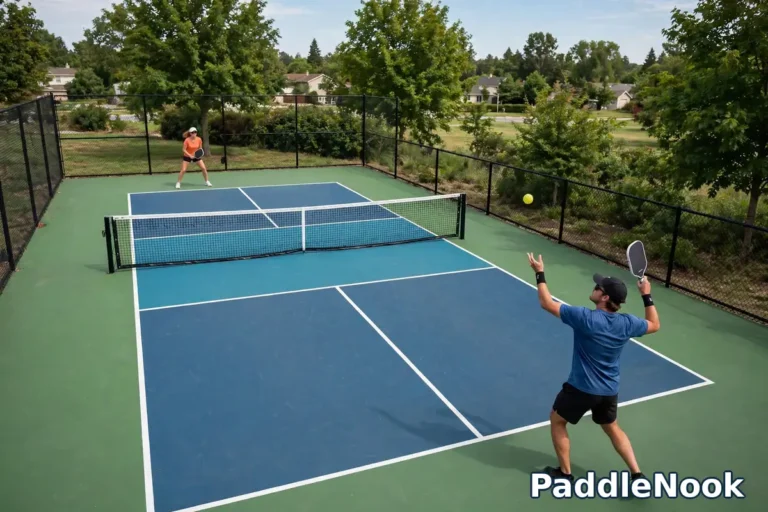
Stand behind the baseline, which is just the back line of the court. Hit the ball underhand, below your waist, with an upward swing, diagonally into the box across from you. The serve must clear the net and clear the kitchen zone.
A drop serve is the kindest first serve. Drop the ball, let it bounce, then hit it after the bounce, without throwing it down.
You get one try at a serve, unless the ball clips the net and still lands in the right box. A serve that lands in the kitchen, or on its line, does not count, and the rally ends.
What Is the Kitchen, Really?
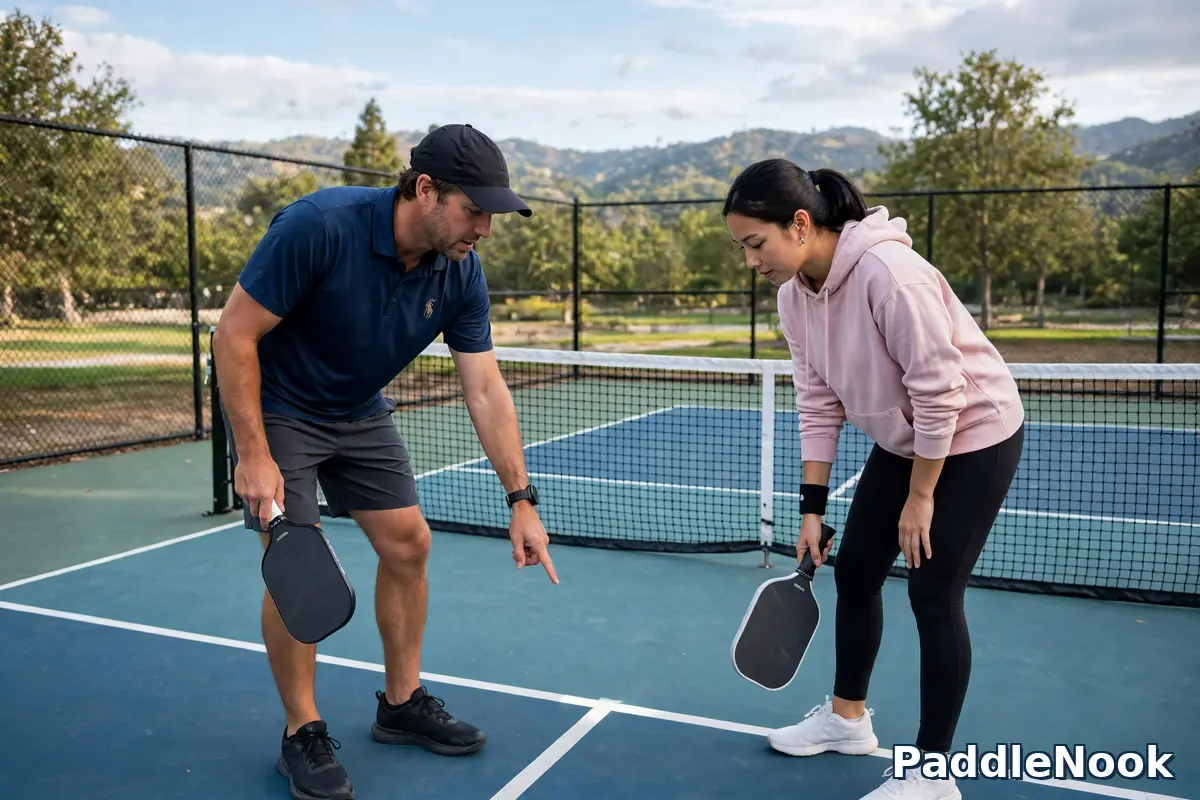
The kitchen is the 7-foot non-volley zone on each side of the net, and its name is the only silly part. You may stand in it any time you like, and you may hit a ball that has bounced while you are in it. You may not hit a ball out of the air while you are in it.
Momentum counts too, so if hitting a ball out of the air carries you into the kitchen, even after the shot, that counts as a fault. Step back, balance, and only then hit another ball out of the air, as shown in a simple definition of the sport.
Why Must the Ball Bounce Twice?
The two-bounce rule sounds fancy, but it is simple: after the serve, each side must let the ball bounce once before hitting it out of the air. The receiving side lets the serve bounce, then the serving side lets the return bounce.
After those two bounces, anyone can hit the ball out of the air, except from the kitchen.
Say it as a little chant before you play: serve, bounce, return, bounce, then play.
How Does Scoring Work, in Plain Words?
Only the serving side scores, which means only the team serving can add a point. Win a rally while serving, and you score one point and keep serving. Win a rally while receiving, and you win the serve back, but not a point.
Call the score call out loud before every serve. At the start, the call is 0-0-2, because only the second server serves first.
What Dumb Questions Are You Afraid to Ask?
Here are the questions new players whisper, with kind answers. Is it okay to be bad at first? Yes, every player was bad at first, and friendly games expect mistakes. Do I have to run fast? No, pickleball courts are small, and smart positioning beats speed.
Can I ask what the score is? Yes, ask any time, and good players will tell you gladly.
What if I break a rule I did not know? Say sorry, replay the point if your group agrees, and carry on. No one remembers your first-game faults, but everyone remembers kindness on court.

What Myths Confuse Beginners Most?
| Myth | Truth |
|---|---|
| You cannot step in the kitchen at all | You can stand there, just not volley from it |
| Only fast players can play well | Smart, soft shots win many friendly games |
| You must win every rally to score | You score only while serving, so patience pays |
| A hard serve is a good serve | A deep, steady serve starts more rallies |
| Asking questions looks silly | Asking questions is how good players learn |
A fault is not a failure, it is just a rule break that ends one rally. Every player faults, in every game, and the next rally starts fresh, with no score carried over from the mistake itself.
USA Pickleball gives a clear overview of the basics on its What Is Pickleball page. Our zone-by-zone tour of the court explains each line in plain words.
People Also Ask
Do I need to know all the rules before my first game?
No. Learn the serve, two bounces, kitchen, scoring, and game end, and learn the rest as you play, one rule at a time.
What if I do not understand a term during a game?
Ask your partner or opponents to explain it in plain words. Good players are glad to help, and you will remember it better next time.
Is pickleball hard for someone who has never played a racket sport?
No.
What should I do if I keep breaking the same rule?
Practise that one rule for ten minutes next time, and ask a patient player to watch. One clear fix beats a long list of worries.
Conclusion
Pickleball rules for dummies are simple once the jargon is gone: serve, bounce twice, stay out of the kitchen for volleys, score only while serving, and play to 11, win by 2. For a complete rules overview in plain words, see the full simple rules guide.
Play your first game without fear of dumb questions, and shake hands at the net, win or lose. Auburn Hills also gives a helpful simple overview in its guide to the rules and basics.



One Comment