Best Pickleball Paddle: Pick One With Confidence
You need one paddle, not a ranking of twenty. If you search for the best pickleball paddle, you will find long lists, prices that change, and terms that mean little before you have played. This guide skips all that. It asks five short questions, turns your answers into a paddle type, and walks you through a simple chooser.
No brand models, prices, or specs are invented here. Prices vary, so check current listings when you are ready to buy. By the end, you will know which type to look for, what to test, and what to ignore. Think of this as a short quiz, not a shopping list. Start with the quiz.
It also tells you what to ignore: rankings, sale signs, and a friend’s paddle, none of which know your game. That focus keeps the choice short. You can finish it in minutes.
Start Here: Five Quiz Questions
Answer with the option that sounds most like you, and note your letters.
1. Where do you win most points?
A. Soft shots, dinks, and careful placement.
B. Hard drives, serves, and attacking shots.
C. A mix of both.
2. How long have you played?
A. I am new, or I play now and then.
B. I play weekly and know my strengths.
C. I play often and want a paddle that grows with me.
3. What tires you first?
A. My wrist, on quick shots at the net.
B. My arm, on long drives from the back.
C. Nothing yet, but I want balance.
4. What frustrates you most?
A. Soft shots that fly too long.
B. Drives that fall short.
C. Off-centre hits that feel weak.
5. How do you like to shop?
A. I want a safe, forgiving first buy.
B. I want a clear strength, even with a trade-off.
C. I want balance, with no big weakness.
Mostly A answers point to control or beginner-friendly types. Mostly B answers point to power types. Mostly C answers, or a mix, point to all-court types. A tie usually means all-court is safest. Write your type down.
Best Pickleball Paddle Chooser: Steps in Order
To pick the best pickleball paddle, first name your type: control, power, or all-court. New players should start all-court or beginner-friendly. Then choose a wide, elongated, or hybrid shape, a thick, thin, or mid core, and a grip that fits your hand. Play one full game before you judge it.
Follow these steps in order. Do not skip step 1, even if a paddle looks good in the shop.
Step 1: Lock your type. Use your quiz result: control, power, or all-court. If you are new, choose all-court or beginner-friendly.
Step 2: Pick a shape. For control or a first paddle, choose a wide body for a large sweet spot, the part of the face that gives the cleanest hit. For power, choose an elongated shape for reach. For balance, choose a hybrid shape.
Step 3: Pick a core thickness. For control, look for a thick core, often around 16 mm. For power, look for a thin core, often around 13 or 14 mm. For all-court play, look for a mid-thickness core. Our guide explains what cores, faces, and grips each do.
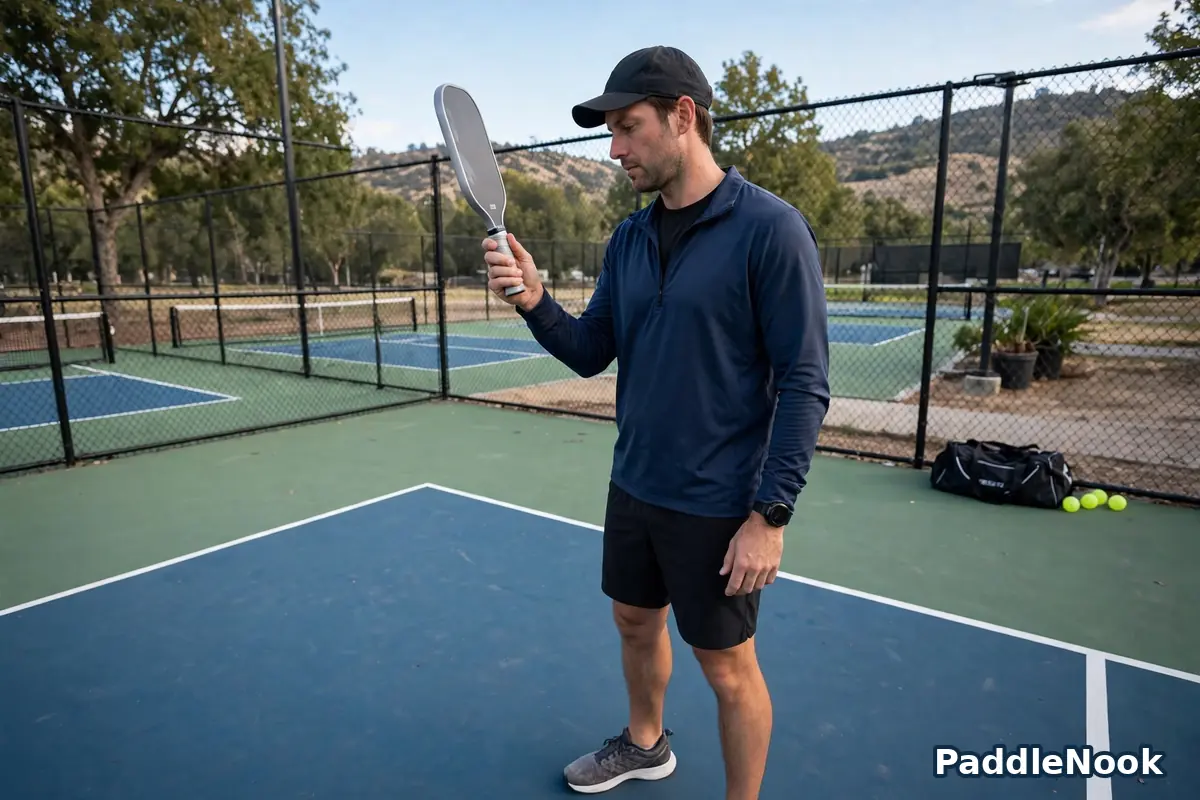
Step 4: Test weight and grip in your hand. Hold the paddle and swing it softly, then firmly. Light feels fast at the net, midweight feels balanced, heavy can tire your wrist. Check the grip: fingers should not overlap your palm, and the handle should not twist.
Step 5: Play one game before you judge. A shop swing is not a game. Borrow or demo first, or use a return policy that allows real play. After one game, ask: Did soft shots stay low? Did drives reach deep enough? Did my wrist feel fresh? Two yes answers mean the type fits; three mean you have found your paddle.
USA Pickleball sets basic equipment rules, and its What Is Pickleball page is a good starting point.
What Mistakes Should You Avoid When You Buy Just One?
Buying one paddle makes each mistake cost more. Do not buy the paddle a stronger friend uses. Do not buy on price alone. Prices vary, and a high price does not prove a fit.
Do not buy two paddles to hedge your choice. One paddle, played for a few weeks, teaches you far more than two played once each. Do not ignore the grip: a wrong size limits your wrist and tires your hand. Do not judge by one bad game. Judge it over two or three games.
To compare types, read how control, power, and all-court types differ. For court footwear to go with your new paddle, see how court shoes grip and fit. A fuller walkthrough is in the Pickleball.com beginner guide.

Takeaway Checklist: Your One-Paddle Shortlist
Copy this checklist for the shop.
- My type: control, power, or all-court (from the quiz).
- My shape: wide, elongated, or hybrid.
- My core: thick for control, thin for power, mid for balance.
- My weight feels quick, not flimsy, and not tiring.
- My grip lets my fingers sit neatly, with no twist.
- I have played at least one full game with it, or I can return it after play.
- I have checked current listings and approved-equipment rules, if relevant.
If you can tick every line, buy that paddle. If you cannot tick the game-test line, do not buy yet.
People Also Ask
What is the best pickleball paddle for a beginner?
A beginner-friendly or all-court type suits most new players.
Should I buy a control or power paddle first?
Most new players should start with control or all-court. Power helps only when you can already place soft shots.
How much should I spend on my first paddle?
Spend what fits your budget for a forgiving type, and check current listings, since prices vary. Do not spend more until you know your preferred weight and shape.
When will I know I need a different paddle?
When you can name a clear gap, such as soft shots flying long, after several games, not after one bad day.
Conclusion
Picking the best pickleball paddle is personal, not a ranking to copy. Answer the five questions, lock your type, pick a shape and core, test weight and grip, and play one game before you judge. Avoid copying a friend’s paddle or buying on price alone. Use the checklist and stop shopping.