
Pickleball Rules for Doubles: Your Ultimate Checklist
Pickleball rules for doubles can feel like a lot to hold in your head at once. You need to remember the serve, the bounce rule, the kitchen, the score call, and who serves next. When one of those slips, the whole game can pause while four players try to work out what should happen next, and the rally loses its flow.
This checklist solves that problem by putting the rules in the order you use them. Start with the pre-game checks, follow one rally from serve to side-out, and use the fault table when a rally ends in doubt. You do not need to learn every rule at once, and you do not need to memorise long lists. Learn the order first, and the rest falls into place. For the core rules in full, see the complete simple rules guide.
What Are the Pickleball Rules for Doubles, in Checklist Form?
Pickleball rules for doubles, in checklist form, are: check the court and net, serve underhand and diagonally, and let the serve and return bounce. Stay out of the kitchen for volleys, score only while serving, call three numbers before each serve, and play to 11 points with a win by 2.
Use that checklist before every game. You will avoid most of the stops and debates that slow down friendly doubles.
Pre-Game Checklist: What Do You Check First?
Check that each team has two players, that the court lines are clear, and that both teams agree on the finish line, usually 11 points, win by 2. Agree on who serves first, and remember that the first serving team gets only one serving turn at the start.
Also agree on how you will call close balls. A ball that touches any part of a line is in, and a call should be made at once by the team on that side. Clear calls before the game save far more time than debates during it.
Rally Walkthrough: How Does One Rally Work?
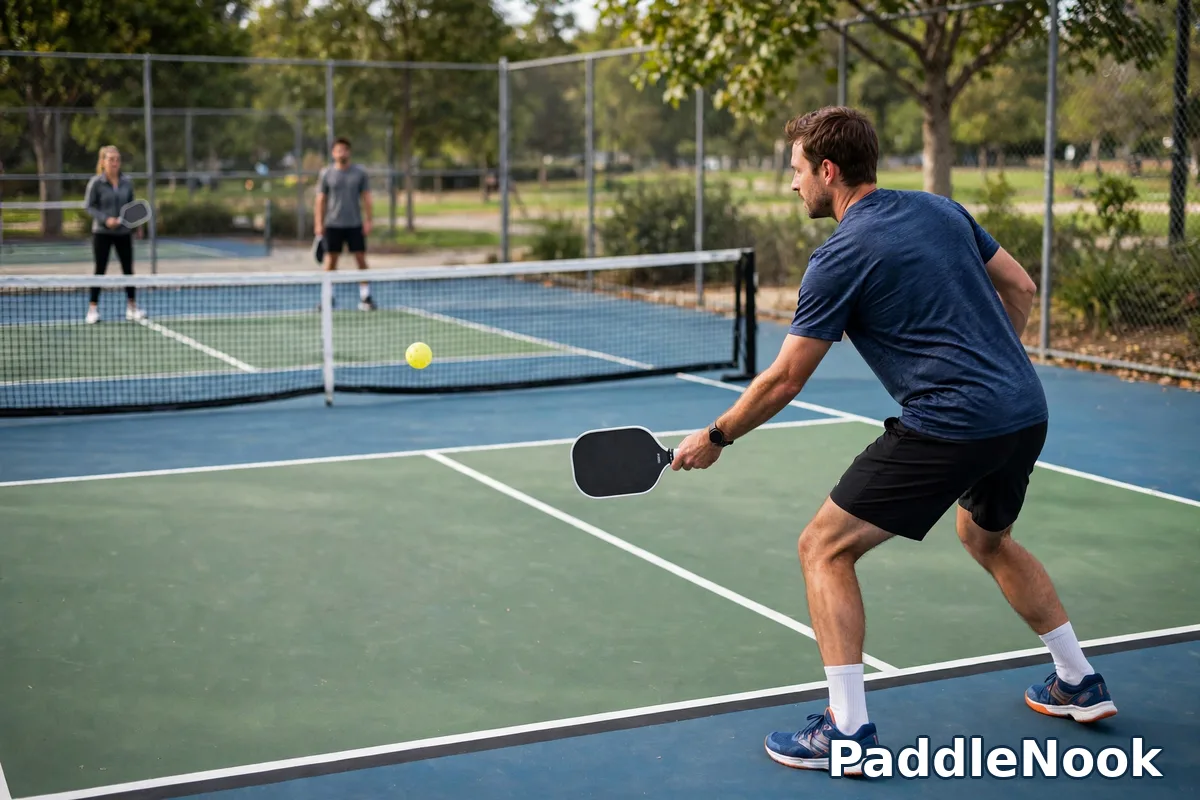
A rally starts with an underhand serve from behind the baseline, diagonally into the opposite box. The receiving team must let the serve bounce, and the serving team must let the return bounce. After those two bounces, volleys are allowed.
Once the rally is open, either team may hit the ball after a bounce or out of the air, except from the kitchen. The rally ends when a fault happens, such as a ball into the net, a ball out of bounds, or a ball that bounces twice on one side.
Serving Turns: Who Serves After a Fault?
When the serving team wins a rally, it scores one point and the same server switches sides and serves again. When the serving team loses a rally, the serve passes to the partner, if the partner has not yet served in that turn.
If both partners have served and lost, the serve passes to the other team in a side-out. The new serving team starts from the right side. That two-server pattern is the heart of doubles, and it is worth rehearsing before a match.
Kitchen and Fault Table: What Ends a Rally?
| Fault | Why the rally ends |
|---|---|
| Volley from the kitchen | No volley while standing in the 7-foot zone or on its line |
| Serve into the kitchen | Serve must land past the kitchen line |
| Ball into the net or out | Ball fails to clear the net or lands outside the lines |
| Double bounce on one side | Ball bounces twice before it is hit |
| Net touch while live | Player, paddle, or clothing touches the net during play |
Momentum faults catch many new players. If you volley and your step carries you into the kitchen, the rally ends even if the shot was good. Step back before you volley again, and the fault goes away.
Score Calls: How Do You Keep Track?
Before each serve, call your score, the other score, and the server number. A call of 4-2-1 means your team has 4, the other team has 2, and the first server is serving. Say it clearly, so both teams hear the same numbers.
If a score is disputed, return to the last score everyone agreed on and replay from there if needed. Do not guess, because one wrong number can change every serve side after it. A detailed scoring walkthrough is given in this essential guide to doubles play.

Common Mistakes: What Should New Doubles Teams Avoid?
Do not rush the net before the two bounces are done. New teams often volley the return of serve, which is a fault, or stand in the kitchen to smash a soft ball. Wait for the bounce, then move forward as a pair.
Do not both chase the same middle ball without a call. A simple call such as “mine” or “yours” stops collisions and lost points. Finally, do not forget the partner turn: losing a rally does not always mean losing the serve to the other team.
People Also Ask
How many players are on a doubles team?
Two players are on each doubles team, so four players are on court in total. Each team serves in turn, with both partners getting a serving turn after the first turn.
Can the receiving team score in doubles?
No, under standard scoring. The receiving team can only win the serve back. It scores points only after it becomes the serving team.
What is a side-out in doubles?
A side-out is when the serve passes to the other team after both partners on the serving team have lost a rally. It changes who serves, but it does not change the score.
Does the serve have to bounce in doubles?
Yes, the serve must bounce on the receiving side, and the return must bounce on the serving side. Only after those two bounces may players volley.
Conclusion
Use the checklist in order, and doubles stops feeling like a memory test. Check the court, serve underhand and diagonal, let the first two shots bounce, keep volleys out of the kitchen, and pass the serve to your partner before it passes to the other team. For scoring detail, see the simple scoring rules guide.
For gear that suits a doubles game, read a plain guide to choosing paddles before you buy. The full Berkeley rules set is also given in this pickleball rules guide.