
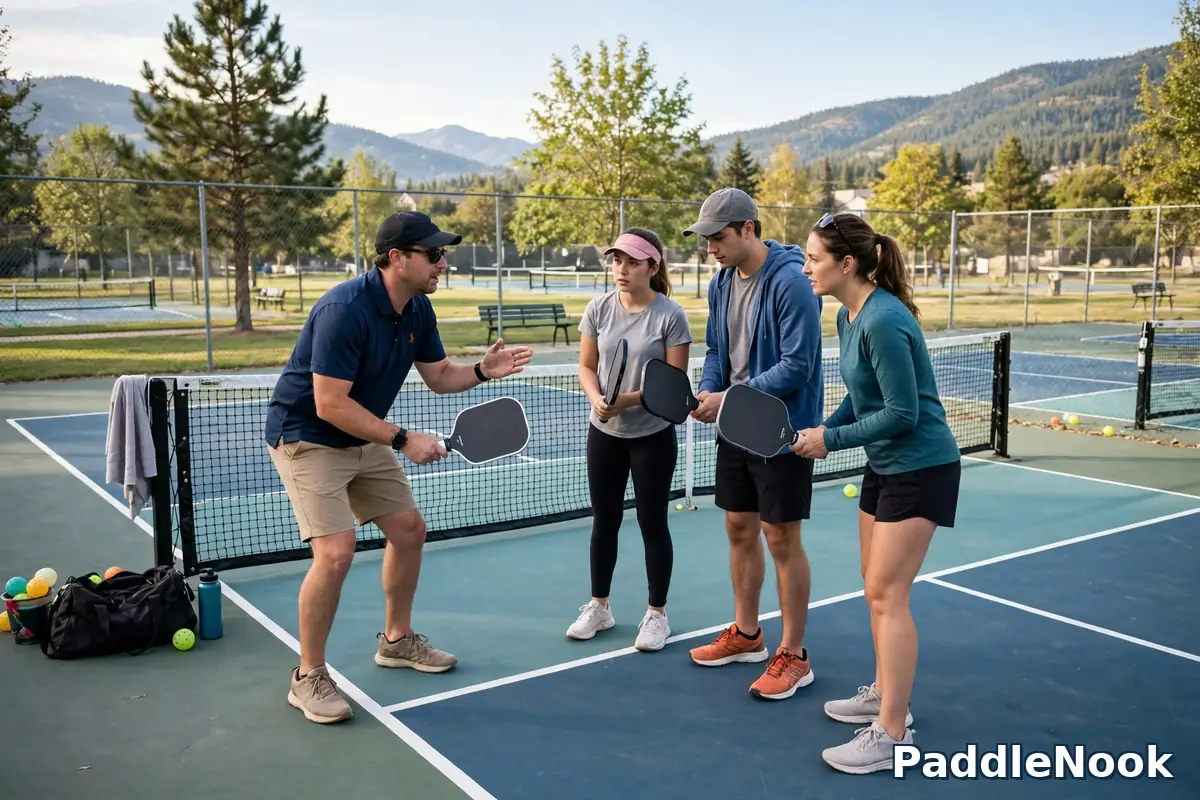
What Are the Basic Rules of Pickleball? The Ultimate Lesson
What are the basic rules of pickleball, and can you really learn them in five minutes? Yes, if you learn one rule at a time, and practise each rule at once, instead of reading a long list and trying to remember it all on court, when the ball is already moving. This lesson does exactly that, with a short drill after every rule, so the rule sticks because you used it, not because you read it.
You do not need a full rulebook, a coach, or a perfect court for this lesson. You need a paddle, a ball, a partner if you have one, and five minutes of calm practice before you play. Work through the minutes in order, without skipping ahead, and by the end, you will be ready for a friendly game.
What Are the Basic Rules of Pickleball, in a 5-Minute Lesson?
The basic rules of pickleball, taught in five minutes, are: serve underhand and diagonally in minute one, let the ball bounce twice in minute two, stay out of the kitchen for volleys in minute three, score only while serving in minute four, and play to 11, win by two, in minute five.
That is the whole lesson in one paragraph. The minutes below turn each rule into a drill, so you do not just read the rule, you feel it. Do each drill for about one minute, then move on.
| Minute | Rule | Drill |
|---|---|---|
| 1 | Serve underhand, diagonal | Ten deep, steady serves |
| 2 | Two bounces | Serve, bounce, return, bounce |
| 3 | Kitchen, no volleys | Soft dinks only, no volleys |
| 4 | Score only while serving | Call the score every serve |
| 5 | Play to 11, win by 2 | Play a short game to 5 |
Minute 1: How Do You Serve?
Stand behind the baseline, with at least one foot behind the line. Hit the ball underhand, below your waist, with an upward swing, diagonally into the opposite service box. The serve must clear the net and clear the kitchen zone.
Drill: hit ten serves, aiming deep and steady, into the back half of the service box. Do not aim for power, and do not worry about a miss. A deep serve gives you time to move forward, while a hard serve that misses ends the rally at once.
A drop serve is a good first choice. Drop the ball, let it bounce, then hit it after the bounce, without throwing it down.

Minute 2: Why Do You Let the Ball Bounce Twice?
The two-bounce rule means the ball must bounce once on each side after the serve, before either side volleys. The receiving side lets the serve bounce, then the serving side lets the return bounce.
Drill: play serve, bounce, return, bounce, then stop. Say the pattern out loud as you play it: serve, bounce, return, bounce, then play. Repeat it five times, until you stop volleying too early.
Minute 3: What Is the Kitchen Rule?
The kitchen is the 7-foot non-volley zone on each side of the net. You may stand in it, and you may hit a ball that has bounced while you are in it. You may not volley while you are in it, or while you or your paddle touches its line.
Drill: play soft dinks only, at the kitchen line, for one minute. Hit slow, low shots that just clear the net, and let any ball that bounces in the kitchen be played from inside it.
Momentum counts too. If a volley carries you into the kitchen, even after the shot, that is a fault. So step back, balance, and only then volley again. For a fuller plain-English overview, see a simple definition of the sport.

Minute 4: How Do You Score?
Only the serving side scores in traditional scoring. Win a rally while serving, and you score one point and keep serving. Lose a rally while serving, and no point is scored, and the serve moves on.
Drill: call the score out loud before every serve, for one minute of play. In doubles, call three numbers: your score, your opponents’ score, and the server number, 1 or 2. At the start, the call is 0-0-2, because only the second server serves first.
If you forget the score, stop, check with your partner and opponents, and agree on it before the next serve.
Minute 5: How Does a Game End, and What Is a Fault?
Games are usually played to 11 points, win by at least 2. At 10-10, play continues until one side leads by 2 points, so a game can finish 12-10, 13-11, or later.
Drill: play a short game to 5 points, win by 2, using all four rules you just practised. Call the score, wait for the two bounces, and stay out of the kitchen for volleys.
A rally ends with a fault: a ball out, into the net, volleyed from the kitchen, or volleyed before the two bounces. A ball on a line is in, except for a serve on the kitchen line, which is out. Our zone-by-zone tour of the court explains each line in plain words.
USA Pickleball gives a clear overview of the basics on its What Is Pickleball page.
People Also Ask
Can I really learn the basics in five minutes?
Yes, for a friendly game. Learn the serve, two bounces, kitchen, scoring, and game end, then add details as you play more games.
Do I need a partner for this lesson?
No. You can practise serves and dinks alone, against a wall or with a partner, and the drills still work.
What should I practise first after the lesson?
Practise the rule you broke most in your first game, for ten minutes next time. One clear fix sticks better than a long list.
What happens at 10-10?
Play continues until one side leads by 2 points. A game at 10-10 is not over, even though one side has reached 10 points.
Conclusion
What are the basic rules of pickleball? Serve, two bounces, kitchen, scoring, and game end, learned in five minutes, one drill at a time. For a complete rules overview in plain words, see the full simple rules guide.
Book a beginner session and follow this lesson. SportsEdTV also gives a helpful full guide in its how to play guide.



One Comment