

Pickleball Scoring: The Ultimate Call-It-Yourself Guide
Pickleball scoring sounds confusing until you call it yourself, and then it clicks fast. The secret is not memorising a long list, but saying the score out loud before every serve, until the three numbers in doubles, or two numbers in singles, feel as natural as saying your own name.
This guide is built for practice, not just reading. You will call scores, track a game, compare singles and doubles, and handle longer games, all in short drills you can do on court. By the end, you will be the player others ask to keep score. You will not need a referee, a chart, or a long explanation, just a clear call before each serve, a little practice with a partner, and the confidence to ask for the score whenever you are unsure.
How Does Pickleball Scoring Work, in One Answer?
Pickleball scoring, in one answer, is: only the serving side scores a point, games go to 11 points and you must win by 2, doubles calls use three numbers, your score, their score, and server number, and singles calls use two numbers, your score and their score.
| Format | Call | Example |
|---|---|---|
| Doubles | Your score, their score, server number | 4-2-1 |
| Singles | Your score, their score | 5-2 |
| Start of doubles | Only second server serves first | 0-0-2 |
| Game end | To 11, win by 2 | 12-10 wins, 11-10 does not |
How Do You Call the Score in Doubles?
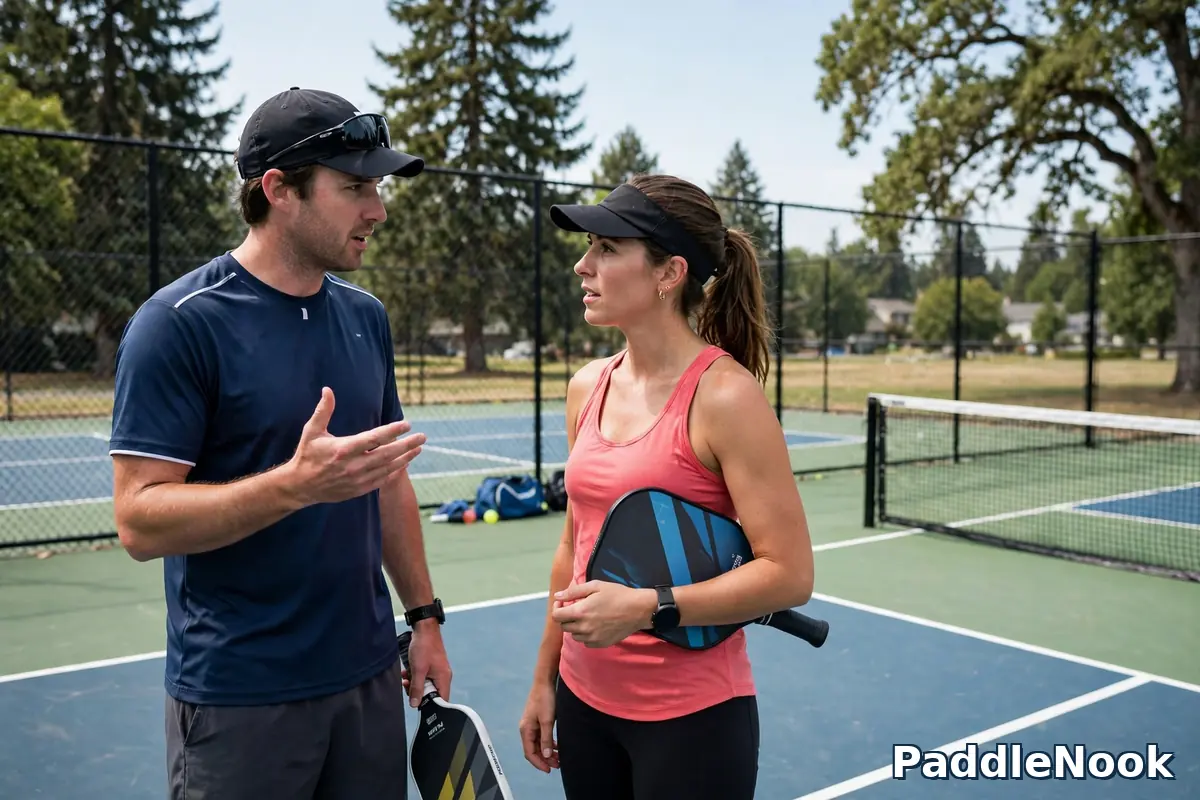
Only the serving side scores, so start every serve with the score call, out loud, before you hit the ball. Call your score first, then your opponents’ score, then the server number, 1 or 2, like this: 4-2-1.
Drill: before your next five serves, say the full call, pause, and check that your partner agrees.
How Do You Call the Score in Singles?
Singles scoring uses the same idea, with one fewer number. Call your score, then your opponents’ score, like this: 5-2, and serve from the right side when your score is even, and from the left side when your score is odd.
Drill: play a short singles game to 5 points, and call the score plus the side, like this: 3-1, serving from the left.
How Do Side-Outs and Server Switches Work?
A side-out is when the serve passes from one team to the other, and it is the moment new scorers misunderstand most. A side-out does not mean a point was scored, it means the serving team has used both of its servers in that turn.
In doubles, after server 1 loses a rally, server 2 serves, and after server 2 loses a rally, it is a side-out. The only exception is the start of a game, when only the second server serves first, at 0-0-2, so one loss can lead to a side-out at once.
The server number is therefore not a ranking, it is just a turn marker. Server 1 and server 2 are equal partners, taking turns, and the number only tells you whose turn it is right now.
How Do You Track a Game, Point by Point?
Use this tracker in your first few games, until calling the score feels automatic. Write the call before each serve, note who won the rally, and write the next call, so you can see the pattern instead of guessing it.
| Call before serve | Rally winner | Call after serve |
|---|---|---|
| 0-0-2 | Serving side | 1-0-2, same server |
| 1-0-2 | Receiving side | 1-0-1, partner serves |
| 1-0-1 | Receiving side | Side-out, other team serves |
| 0-1-1 | Serving side | 1-1-1, same server |
A fault ends the rally, but it does not automatically add a point. A fault by the serving side changes the server, not the score, while a fault by the receiving side gives the serving side one point. That distinction is the most common scoring mistake, and the tracker makes it visible.
For a fuller plain-English overview, see a simple definition of the sport. Our zone-by-zone tour of the court explains each line in plain words, when you need to check a line call.
What About 15 and 21 Point Games?
Most friendly games go to 11 points, win by 2, but some tournaments and leagues play to 15 or 21 points, still win by 2. The scoring rules do not change, only the target number changes, so the same calls, server switches, and side-outs apply.
At 10-10 in an 11-point game, play continues until one side leads by 2 points, so a game can finish 12-10, 13-11, or later. The same win-by-2 rule applies at 14-14 in a 15-point game, and at 20-20 in a 21-point game.
What Mistakes Do New Scorers Make Most?
The first mistake is adding a point after every rally, even when the receiving side won it. Remember: only the serving side scores, so a receiving win only wins the serve back, not a point, until that team is serving itself.
The second mistake is forgetting the server number in doubles, and calling only two numbers. That mistake hides whether the serve will pass to a partner or to the other team, so always call all three numbers in doubles.
USA Pickleball gives a clear overview on its What Is Pickleball page.
People Also Ask
Why does every doubles game start at 0-0-2?
Because only the second server on the starting team serves first. That rule stops the starting team from getting two service turns right at the start.
Does losing a rally always cost a point?
No. Only the serving side scores, so a receiving win wins the serve, not a point, until that team is serving itself.
What is the easiest way to learn scoring fast?
Call the score before every serve, track one game on paper, and play short games to 5 points until the pattern feels natural.
Can I use rally scoring in a friendly game?
Yes, if your group agrees before the game. In rally scoring, every rally scores a point, but start with traditional scoring until the basic calls feel easy.
Conclusion
Pickleball scoring is one rule plus practice: only the serving side scores, to 11, win by 2, with three numbers in doubles and two in singles. For a complete rules overview in plain words, see the full simple rules guide.
Call the score before every serve in your next game, and use the tracker above until it feels automatic. A win by two finish will then feel normal, not confusing, and Olaben also gives a helpful breakdown in its how to score guide.

5 Comments